When a fence sits on the line between two properties, the first question is often who pays for it. In Ontario there’s no automatic 50/50 rule. Most neighbours simply agree between themselves — and when they can’t, the province has a formal process. Here’s how it works, in plain language.
This is general information, not legal advice. For your situation, check with your municipality or a lawyer.
The Short Answer
Neighbours can split the cost of a boundary fence any way they agree to. If you can’t agree, the Line Fences Act lets either owner ask the municipality for fence-viewers, who decide how the work and cost are shared. But it has to happen before you build: if you put up a new fence on your own and then ask your neighbour to pay part of it, the Act’s process doesn’t apply.
Start With a Conversation
Most shared fences are settled over the back fence, literally. Before you book a quote, talk to your neighbour about:
- Height and style — what you both can live with, within your city’s by-law.
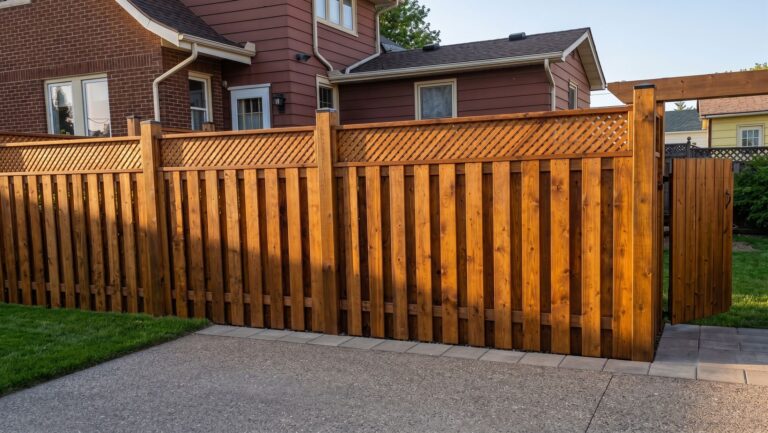
- Which side faces whom. Board-on-board and shadow-box styles look the same from both sides, which avoids the “who gets the good side” question.
- How the cost is split — half and half, by length of each yard, or one owner pays and owns the decision.
- Timing and access. The crew may need to work from both sides of the line.
Write down what you agreed — a short email that you both reply to is better than nothing.

When You Can’t Agree: the Line Fences Act
The Line Fences Act provides a dispute process between owners of neighbouring properties in most of Ontario. According to the Province of Ontario, it applies when:
- there is no fence on the boundary and one owner wants a new one, or
- a boundary fence exists and one owner thinks it needs to be rebuilt or repaired.
Either owner can ask the municipality to appoint fence-viewers. They visit the property and make a written decision (an “award”) about how responsibility for the work is shared, and can describe the fence and its materials. The award also splits the cost of the process itself.
Things to know
- It only covers boundary fences. A fence fully inside your own property is yours.
- It doesn’t decide where the line is. If you disagree on the boundary itself, that has to be sorted out first — usually with a survey.
- Build first, ask later doesn’t work. If one owner builds or rebuilds the fence on their own and then wants the neighbour to pay, the process doesn’t apply.
- Your city may have opted out. A municipal council can exempt all or part of the municipality from the Act and set its own rules by by-law. Check with your city.
- Appeals are short. An owner has 15 days from receiving the certified award to appeal. The appeal fee in 2026 is $406.05.
Fence on the Line or Just Inside?
Some homeowners avoid the shared-cost question by building the fence just inside their own property. It’s then their fence: they choose the style, pay for it and maintain it. You give up a few inches of yard, but you don’t need anyone else’s agreement on the design — you still need to follow your city’s fence by-law.
How We Help
On shared fences we’re happy to meet both neighbours on site, measure once and send one itemized quote you can split however you agreed. Ask us when you book. We build across the GTA and Niagara — see our recent projects.
Planning a shared fence? Call 437-922-9070 or request a free quote. We measure on site and send a clear, itemized price, usually within 24 hours. No deposit: you pay when the fence is done.
FAQ
Do neighbours have to split the cost of a fence in Ontario?
There is no automatic rule. Neighbours can agree on any split. If they cannot agree, the Line Fences Act lets either owner ask the municipality for fence-viewers, who decide how the cost is shared.
Can I make my neighbour pay for a fence I already built?
Not through the Line Fences Act. Its process does not apply when one owner builds or rebuilds a boundary fence on their own and then asks the neighbour to share the cost.
Who decides where the property line is?
Not the fence-viewers. The Act does not settle boundary disputes. A survey is the usual way to confirm the line.
Can I build a fence just inside my property instead?
Yes. A fence fully on your own property is yours to design, pay for and maintain, as long as it follows your city’s fence by-law.